Roman Britain in the Cotswolds: A Self-Guided Tour of Cirencester and Nearby Sites
Corinium Dobunnorum was the capital of the Dobunni and, for a century or two, the second-largest town in Roman Britain. Today it is Cirencester: a compact Cotswold market town whose Roman bones lie a metre or so beneath the pavement, mostly invisible, occasionally spectacular. What survives above ground is modest — a great earthwork amphitheatre, a scatter of villas in the surrounding valleys — but the museum in the middle of town holds one of the finest collections of Romano-British mosaics in the country.
The route below works as a half-day in Cirencester itself, with two nearby sites that turn it into a full day if you have the appetite. It assumes a car for the second half; everything in the town is walkable.
Start at the Corinium Museum
Park Street, a few minutes from the market square, and give it ninety minutes at the very least. The galleries run from the Iron Age Dobunni through the Roman town to the Anglo-Saxons, and the objects of ordinary life — hairpins, hobnails, gaming counters, a child's tiny leather shoe — are as memorable as the showpieces.
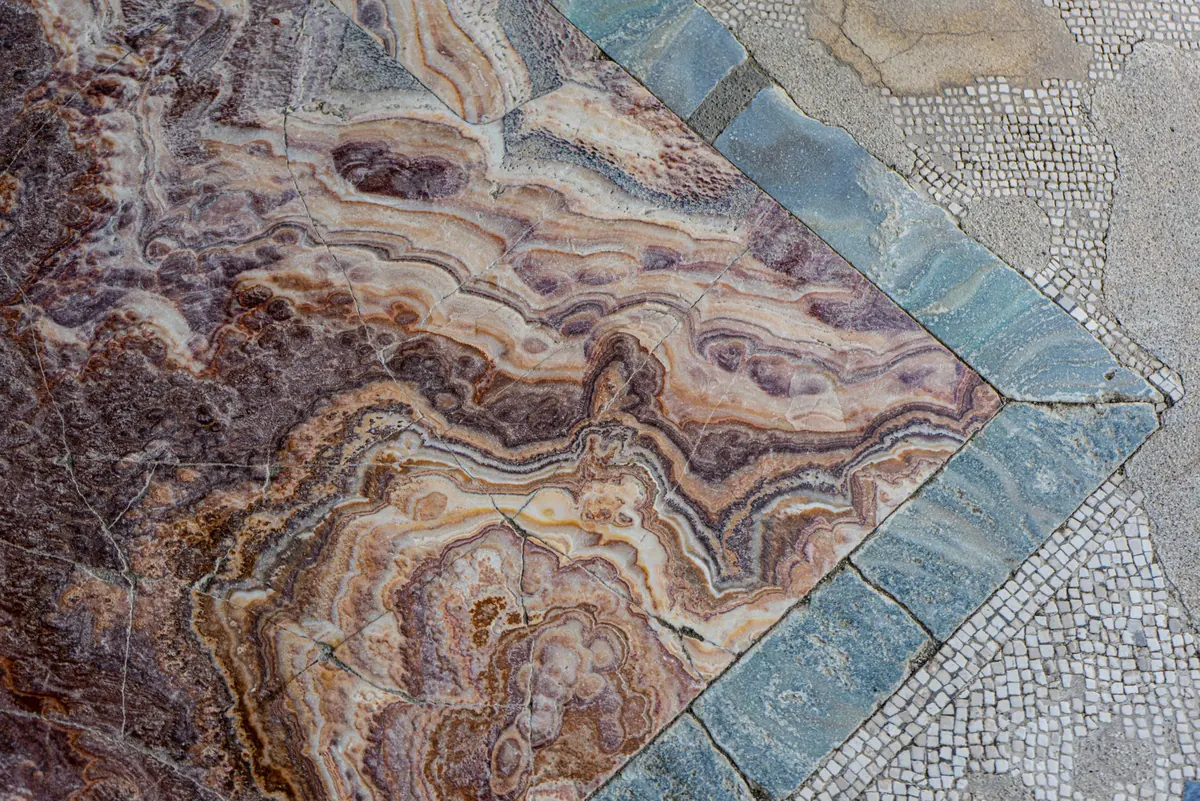
The mosaics are the reason most people come. They were lifted whole from Roman floors in and around Cirencester and relaid in the galleries, so you can walk right up to them. The Hare Mosaic, found on Beeches Road, is the one visitors remember: a hare in a roundel at the centre of a geometric floor, still crisp in colour after sixteen centuries. Look closely at the box flue tiles and painted wall plaster nearby — they explain how a Roman room actually worked, which makes the villa sites later in the day far easier to read.
Reading Roman Cirencester on Foot
Almost nothing in the town centre stands above a few courses of stone, so the pleasure here is in noticing rather than looking at. The forum and basilica, the administrative heart of the civitas, lay under and around today's market square. The street pattern still carries an echo of the Roman grid in places, and the line of the town walls can be traced on the ground if you know where to look — a scatter of low earthworks and buried remains rather than a monument.
Two things worth doing as you walk:
- Look at the walls of older buildings and boundary walls around the churchyard. Roman tile and dressed stone were quarried from the ruins for centuries, and you can spot reused fragments without much effort once your eye is in.
- Stand in the market square and remember that you are roughly at the centre of a town that was, for a while, larger than anything else in Britain except Londinium.
The Amphitheatre
From the town centre it is a fifteen-minute walk up Cotswold Avenue towards the Royal Agricultural University. The amphitheatre is free, open all year and has no facilities at all, which is part of its charm: two enormous grassy banks and a hollow between them, with a later stone castle motte dumped in one corner by the Normans.
It is one of the largest Roman amphitheatres in Britain, and the scale only registers when you stand at the bottom looking up. Timing matters. Go in low winter light or early evening, when the shadows show the tiers of seating; in flat summer sun it can read as nothing more than a pleasant dip in the ground. Wear something you don't mind getting muddy and stick to the paths — the banks erode if everyone scrambles over them.
Chedworth Roman Villa
Roughly eight miles north-east of Cirencester, down lanes near Yanworth, Chedworth was found in 1864 and is now cared for by the National Trust. It holds one of the best collections of Roman mosaics still in their original positions anywhere in Britain, protected by cover buildings you walk through.
Allow two hours, including the café. What stays with most people:
- The north range floors, where you can follow the pattern of rooms and corridors as the villa grew and was remodelled.
- The water shrine, a nymphaeum built over a spring that still runs today — the reason the villa was sited here in the first place.
- The small museum of finds, which makes sense of the shells, coins and bones you have just walked over.
The lane is narrow and parking is limited, so arriving before midday makes life easier. Part of the site is closed outside the main season; check before you set out, and stay behind the barriers — hand oils and mosaic tesserae are not friends.
Great Witcombe, and the Buried Pavement at Woodchester
If you have a spare hour, head west towards Birdlip to Great Witcombe Roman Villa, an English Heritage site with free entry. It is a courtyard villa on a spring line below the escarpment, with the plan of a substantial bath suite still legible in the walls. Forty-five minutes is enough, and it contrasts nicely with Chedworth's polish.
Near Stroud, at Woodchester, lies the Great Orpheus Pavement — a vast and extraordinary mosaic that has been reburied to protect it and is only rarely exposed to view. If an opening coincides with your trip, take it. Otherwise, treat it as a reason to come back.
The Half-Day Route at a Glance
- 10:00 — Corinium Museum, Park Street. Ninety minutes minimum.
- 11:45 — Walk the market square and surrounding streets, looking for reused Roman stone.
- 12:30 — On foot to the amphitheatre via Cotswold Avenue; half an hour on site.
- 13:15 — Lunch in town.
- 14:00 — Drive to Chedworth Roman Villa for the afternoon, or to Great Witcombe if you want something shorter.
Practical Notes
Cirencester has no railway station. The nearest is Kemble, about four miles away, with taxis usually waiting; buses run in from Swindon and Gloucester. Chedworth and Great Witcombe are effectively car-only — there is no sensible public transport, and the lanes are single-track in places.
Ground at the amphitheatre and both villas is uneven and often wet underfoot, so proper shoes beat trainers. Opening days at the museum and at Chedworth vary by season, and National Trust properties sometimes reduce hours in winter, so check the day before rather than assuming. In town, the cafés and pubs around the market square fill up at weekend lunchtimes; booking is sensible. And if you want to see the mosaics properly, take your time — the best of them reward a second slow pass.
Photo: Jiří Dočkal / Pexels